Why Bedroom Count Changes the Math
When a group is comparing 2-bedroom, 3-bedroom, and 4-bedroom apartments, the instinct is to think purely in terms of rent per unit. But the more useful comparison is structural: a single lease that covers more bedrooms spreads its fixed costs — the application fee, the security deposit, the utility setup — across a larger household. Those costs do not scale up proportionally with bedroom count, which changes the economics of the whole arrangement as the group gets bigger.
Capitol Living does not set or advertise a per-room or per-person rate. Every lease is a single whole-unit agreement, and residents are free to divide the total cost among themselves however works best for their household.
Fixed Costs Don't Multiply With Bedrooms
Consider what stays flat regardless of how many people are on the lease: one application process, one security deposit, one internet setup, one water and wastewater account. On a 2-bedroom lease, those fixed costs are shared by two people. On a 4-bedroom lease, the same fixed structure is shared by up to four. That is the core of the group cost math — it is not that a 4-bedroom unit is cheaper in absolute terms, it is that its fixed overhead gets distributed across more residents.
This is also why larger groups often find that a well-designed 4-bedroom unit gives them access to shared amenities — a bigger kitchen, more common living space — that a 2-bedroom simply cannot offer at any price.
What to Check as Bedroom Count Rises
More bedrooms is only a good deal if the layout keeps up with the headcount. A few things worth checking before committing to a larger unit:
- Bathroom ratio. A 4-bedroom unit with only one bathroom creates daily friction that a 2-bedroom with the same ratio would not. Capitol Living's 4-bedroom units are built with two full bathrooms, a roughly 2:1 bedroom-to-bath ratio that keeps morning routines manageable.
- Bedroom parity. Bedrooms that are close in size reduce arguments about who "got the good room" — worth asking about directly if you're comparing floor plans.
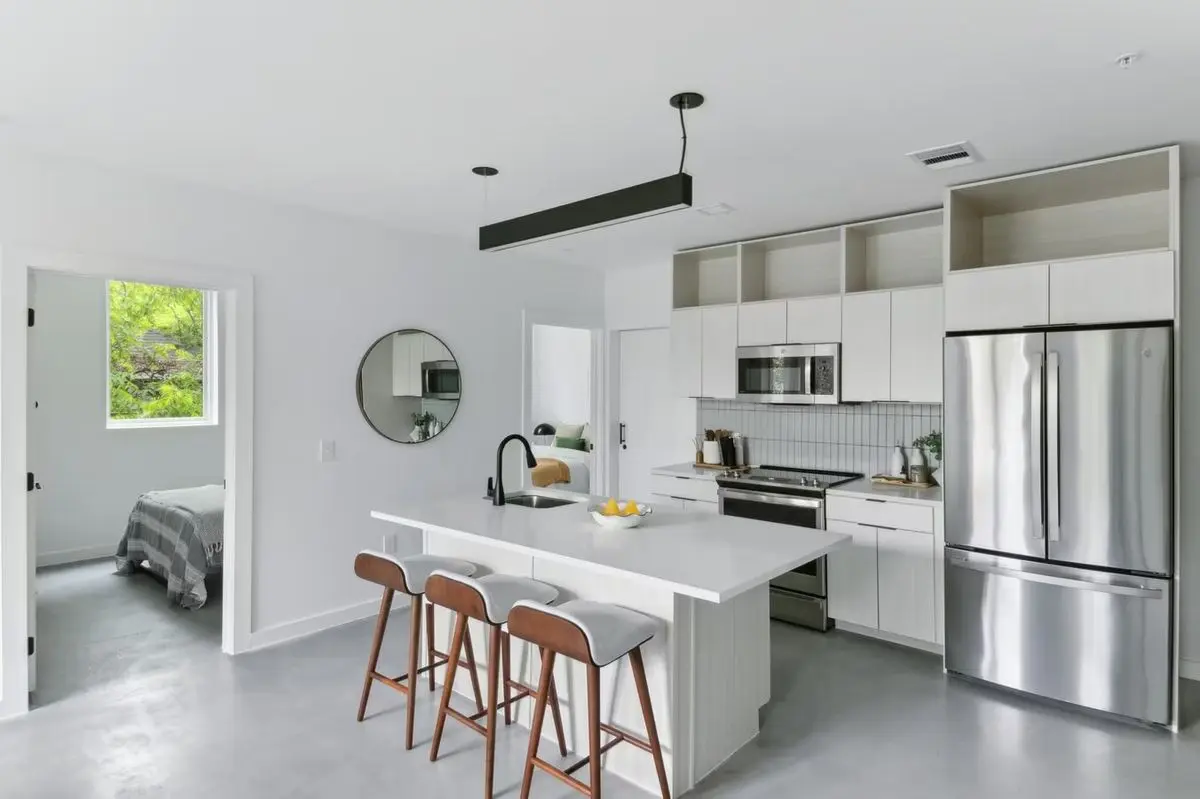
- Common space capacity. A kitchen and living area built for two people can feel cramped with four. Capitol Living's roughly 1,000-square-foot 4-bedroom layout includes an open-concept kitchen with island seating designed around a full household, not an afterthought.
How Groups Typically Handle Internal Splitting
Because the lease is structured as a single whole-unit agreement, how the total is divided among roommates is entirely between the residents. Some groups split evenly regardless of room size; others adjust based on room size, closet space, or bathroom access. Capitol Living does not set or advertise a per-room or per-person rate — that division is a private arrangement the group works out among themselves, and it is worth agreeing on it in writing before move-in to avoid confusion later.
The Takeaway for Comparison Shopping
When you are weighing a 2-bedroom against a 3- or 4-bedroom option, do not compare rent figures in isolation. Compare the full structure: fixed costs shared across the household, bathroom-to-bedroom ratio, common space size, and whether the private bedrooms in the unit are laid out evenly. A larger unit with the right layout can end up being the more efficient choice for a group, even before anyone does the math on how they'll split the total.
Frequently Asked Questions
Does Capitol Living charge a per-person or per-bedroom rate?
No. Capitol Living does not set or advertise a per-room or per-person rate. Each unit is leased as a single whole-unit agreement, and residents decide privately how to divide the total among themselves.
How many bathrooms are in a Capitol Living 4-bedroom unit?
Capitol Living's 4-bedroom units include two full bathrooms, a roughly 2:1 bedroom-to-bathroom ratio.
Do fixed lease costs increase with more bedrooms?
Fixed costs like the application fee, security deposit, and utility setup are tied to the lease as a whole, not to the number of bedrooms, so they get shared across more residents as bedroom count rises.
What should a group check before choosing a larger unit?
Check the bathroom-to-bedroom ratio, whether bedrooms are similar in size, and whether the kitchen and common areas are sized for the full group, not just the bedroom count.