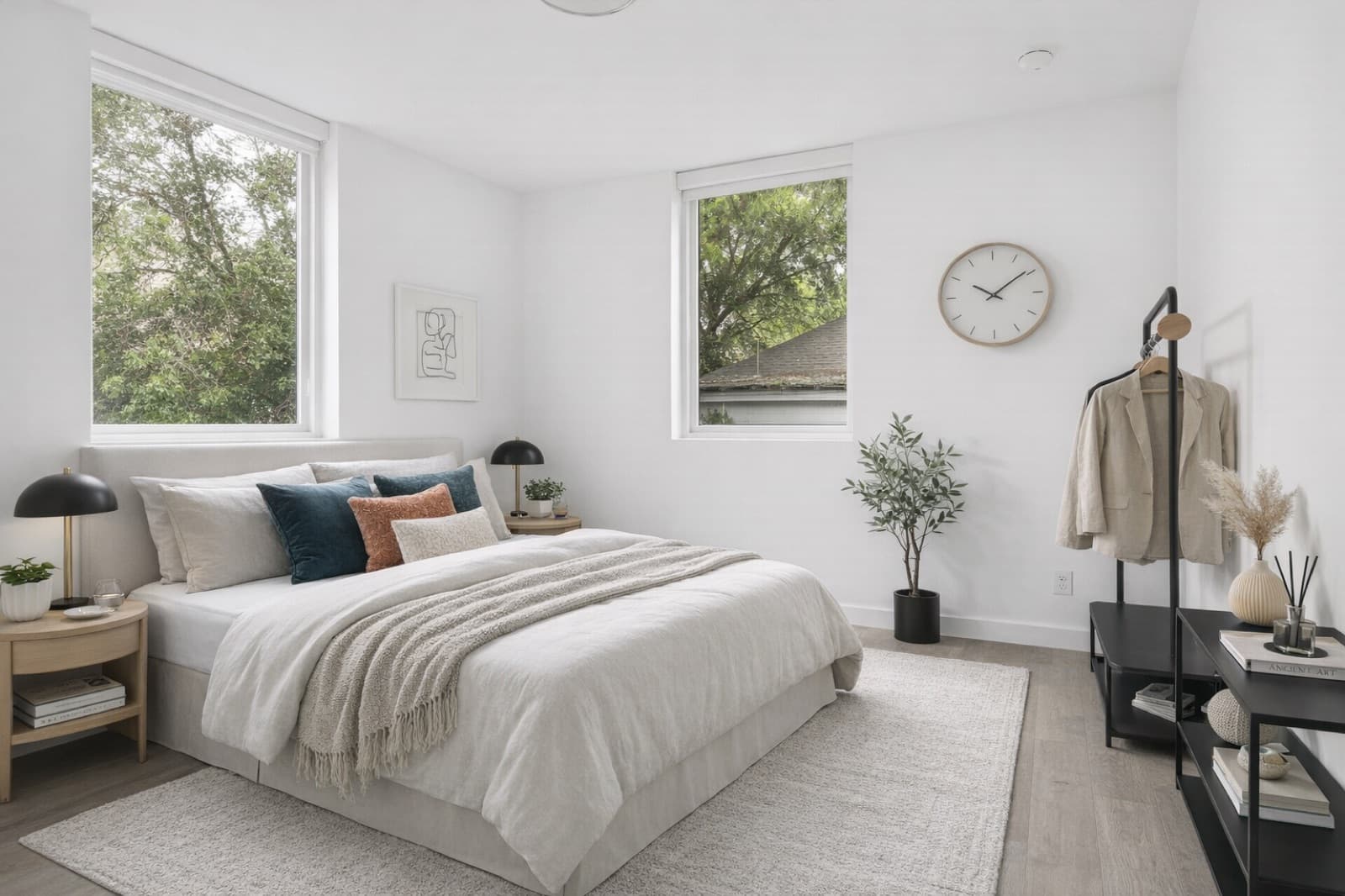
Why the Label Matters When a Group Counts Rooms
A listing says four bedrooms, a group of four signs up, and only later does someone notice that one of the rooms has no door or no closet. The word on the listing and the room itself are not always the same thing. Labels like bedroom, den, flex room, or office are applied by whoever writes the listing, so the safest approach is to learn how to read past them.
This post is about telling the difference from a listing or a floor plan. For the physical checklist you use in person, our guide on what makes a real bedroom in a shared apartment goes room by room.
How Listings Use These Words
You will see many names for spaces that are not clearly bedrooms: den, flex room, bonus room, office, study, loft, nook, and sunroom. Some of them describe a room that really can function as a private bedroom. Others describe an open area, or a room that is meant for another use. There is no single definition shared by every listing, which is why the label alone tells you very little.
What Usually Separates a True Bedroom From a Flex Room
The physical checklist, covering the door, window, closet, and heating and cooling reach, is in the guide linked above, so we will not repeat it here. On a listing, the point is simply that any of those can be missing from a flex space.
Rules about sleeping rooms, including window requirements, vary by jurisdiction and by lease, so do not assume a room is allowed to be used as a bedroom because it could physically fit a bed. Ask.
Reading a Floor Plan
Floor plans show more than listings do. Look at how each room is drawn. Is there a door symbol? Is there a closet shown inside the room? Is there a window on an exterior wall? Does the room open directly onto the living area, or does it have its own entry off a hallway? Compare room sizes too, since a room labeled bedroom that is far smaller than the others is worth questioning. Our guide on touring an apartment as a group helps you confirm these details in person.
The Group Math
For a group, the question is not how many rooms exist but how many private, lease-permitted bedrooms exist. If the number of adults is greater than the number of true bedrooms, someone ends up in a space that may not be allowed to be occupied that way, or the group takes on a risk the lease does not cover. Ask the leasing office in plain terms which rooms may be occupied as bedrooms under the lease, and get the answer in writing.
Also ask whether a flex room is included in the rent as a shared space and what the lease says about how it may be used. A shared flex room can be a genuine advantage, as long as everyone knows what it is and is not.
A useful habit is to write down, before you start touring, the number of private bedrooms your group needs. Then compare every listing against that number instead of the headline room count. If a listing falls short once the flex space is set aside, you have found out before the application fee, not after.
How Capitol Living Describes Its Layout
Each Capitol Living apartment has four private bedrooms, a versatile sunroom, and two full bathrooms in roughly 1,000 square feet. The four bedrooms are described as equal. The sunroom is a versatile shared flex space. It is not a fifth bedroom, and it cannot be leased or occupied as one.
That distinction is the point of this post. If you count rooms for your group, count four. The sunroom is extra shared space on top of that, and our post on how people use a sunroom as bonus space looks at how households use it. The private bedrooms downtown Austin page shows the bedrooms themselves.
Questions to Ask on Any Listing
- Which rooms are intended and permitted to be used as bedrooms under the lease?
- Does each of them have a door, a closet, and a window?
- Is any flex room included in the rent, and how may it be used?
- Can I see the floor plan with room dimensions?
- How many bathrooms are there for the number of bedrooms?
Put the answers in writing before anyone signs.
Common Listing Traps
A few patterns are worth watching for when you compare listings:
- A room labeled bedroom that has no window or no door.
- A dining area or open loft counted as a bedroom to raise the room count.
- A den listed as a bonus, but priced and advertised as if it were a bedroom.
- Room counts in the headline that do not match the floor plan.
- Photos that show a flex room staged with a bed.
None of these automatically means the listing is dishonest. They are reasons to read the floor plan and ask the question directly.
Why This Matters for Cost Splitting
Groups divide rent by the number of private bedrooms or by a fairness method they agree on. If one room is not really a bedroom, a split that treats it like the others will feel unfair quickly. Even when everyone agrees to the arrangement, the lease may not allow it. Settling the room count first means the rent conversation is about numbers you can trust.
What a Real Flex Room Is Good For
None of this is a knock against flex space. A genuine shared flex room can serve a household well, whether the group needs a place to work, spread out, or host a friend for an afternoon. The problems start only when a flex room is treated as something it is not. Know what it is, agree how it will be used, and you get the benefit without the risk.
Take It to a Tour
The fastest way to settle all of this is to see the rooms. Schedule a tour of Capitol Living and compare the bedrooms and the sunroom for yourself. If your group is still sorting out how to share a lease, the apartments for roommates overview explains how a whole-unit lease works.
Questions about the layout? Contact the leasing team.
Frequently Asked Questions
What is the difference between a bedroom and a den?
A bedroom is a private room intended and permitted for sleeping, typically with a door, a closet, and a window. A den or flex room is a space with a looser purpose. Because listings use the words loosely, check the floor plan and ask the leasing office how the lease treats the room.
Can a flex room count as a bedroom on a lease?
That depends on the lease and the property, and it should not be assumed. Ask the leasing office which rooms may be occupied as bedrooms, and get the answer in writing. At Capitol Living, the sunroom cannot be leased or occupied as a bedroom.
Why does room count matter when sharing an apartment?
A group needs to know how many private, lease-permitted bedrooms exist, because that determines who has a real private space. Counting a flex room as a bedroom can leave someone without proper sleeping space or put the group outside the lease terms.